Achieving Accurate
Pressure Measurement
in Bioprocessing
Comparative evaluation of pressure measurement performance across 0.5–45 PSI using Ashcroft® instrumentation — assessing accuracy, signal stability, and integration reliability in single-use systems.
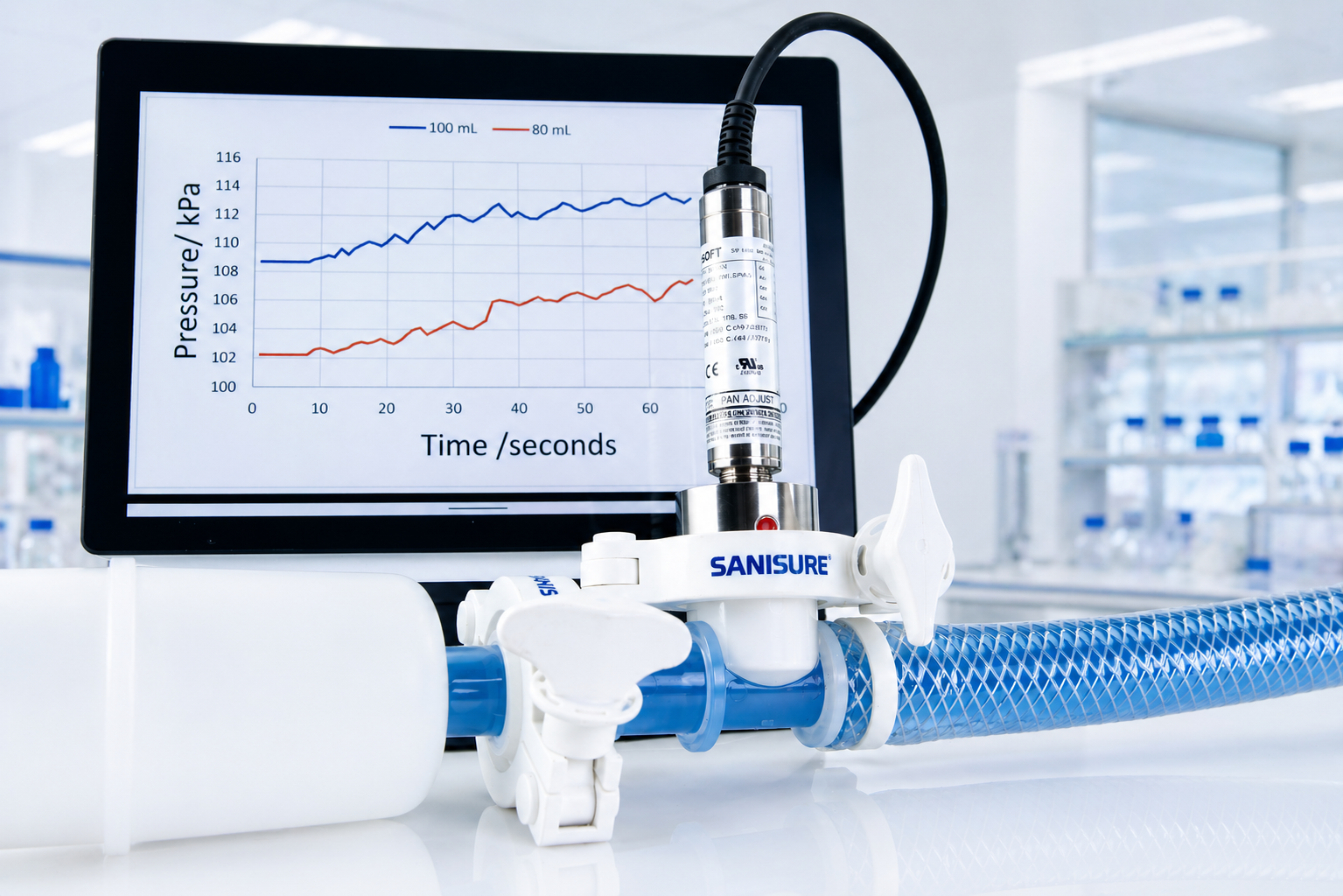
Pressure Measurement Plays a Critical Role in Bioprocess Control
Pressure measurement plays a critical role in maintaining process control, product quality, and operational consistency across biopharmaceutical manufacturing. However, not all pressure sensing technologies perform consistently under real operating conditions.
This white paper evaluates pressure measurement accuracy using an Ashcroft® pressure transmitter across a typical working range of 0.5–45 PSI. Comparative analysis highlights a key limitation in traditional MEMS-based single-use sensors: measurement error increases as operating pressure rises, introducing variability into otherwise controlled processes.
In contrast, aSURE™ Instrument Tees demonstrate stable, NIST-traceable accuracy across the full operating range, enabled by a mechanical diaphragm interface that eliminates signal drift and electronic instability.
The paper explores:- Comparative error performance versus MEMS-based sensors
- Impact of signal drift on process reliability
- Integration with standard sanitary instrumentation
- Implications for upstream and downstream applications
This technical resource provides bioprocess engineers and MSAT teams with practical insights into improving pressure measurement accuracy while reducing process variability and risk.
Why This Matters to Your Process
Four findings from the comparative evaluation with direct implications for filtration, transfer, and process control performance.
In MEMS-based single-use pressure sensors, measurement error increases as operating pressure rises. This means the sensors are least accurate precisely where process variability has the greatest consequence.
Voltage instability in embedded electronic sensors creates signal drift during filtration, transfer, and control steps — degrading batch consistency and making reproducibility harder to demonstrate to regulators.
aSURE™ Instrument Tees deliver NIST-traceable, stable pressure data across the full 0.5–45 PSI operating range. Consistent readings directly support batch-to-batch reproducibility and simplify deviation investigation.
Because aSURE™ Instrument Tees work with standard sanitary gauges and transmitters — with no embedded electronics in the fluid path — they integrate into existing process architectures without requiring new qualification work for the instrumentation itself.
Pressure Measurement Accuracy
Across Bioprocess Ranges
Comparative evaluation of aSURE™ Instrument Tees with Ashcroft® pressure transmitter versus leading MEMS-based single-use pressure sensors across a typical bioprocess operating range (0.5–45 PSI).

aSURE™ Instrument Tees maintain low measurement error (≤0.03 PSI) across the full 0.5–45 PSI range.
MEMS-based sensors show increasing error as pressure rises, reaching >0.8 PSI at 32 PSI — 27× higher than aSURE™.
Lower, more consistent error supports reliable pressure monitoring, process control, and product quality.
Accuracy without signal drift via a hermetically sealed diaphragm and compatible process instrumentation.
Consistent accuracy where it matters. aSURE™ Instrument Tees deliver stable, reliable pressure measurement across typical bioprocess operating ranges — reducing variability and supporting process performance.
Test data based on evaluation using an Ashcroft® pressure transmitter (gamma-irradiated) compared to published specifications from a leading MEMS technology competitor.
Range: 0.5–45 PSI | Sterilization: 50 kGy Gamma Irradiation | Reference: See full white paper for test methodology and data.
Where MEMS-Based Sensors Create Process Risk
Biopharmaceutical manufacturers rely on pressure measurement at multiple points in upstream and downstream processing — across filtration, transfer, hold steps, and closed-system fluid handling. When the sensing technology introduces its own variability, the measurement itself becomes a source of process risk rather than a control point.
| Limitation | Root Cause | Process Consequence |
|---|---|---|
| Error increases with pressure | MEMS piezoelectric response is non-linear at higher pressures in single-use formats | Inaccurate readings at critical high-pressure operating points; incorrect TMP calculations in filtration |
| Signal drift over time | Embedded electronics exposed to process conditions experience voltage instability | Batch-to-batch variability; increased deviation investigations; harder reproducibility demonstration |
| Electronics in the fluid path | Single-use MEMS sensors integrate transducer and electronics in one disposable unit | Each sensor unit must be individually validated; high per-use cost for GMP applications |
| Limited instrument compatibility | Proprietary electrical interfaces require matched readout hardware | Instrumentation lock-in; increased qualification burden when scaling or changing suppliers |
Accurate Data.
Whether you’re troubleshooting measurement variability, scaling a process, or qualifying a new single-use platform, our team can walk you through how aSURE™ Instrument Tees integrate with your existing instrumentation.