Roller bottles have been described to me as the “dirty little secret” of the biotech and pharma industry. They are an old technology, rarely spoken of, that has barely changed in decades, and yet their use is still everywhere in commercial manufacturing. How can that be? With new cell culture technologies emerging seemingly every week, how has the humble roller bottle not only held its place, but kept growing in demand?
Simplicity is King
Roller bottles are not a complex technology, and that is precisely the point. It is their simplicity that makes them so robust and reliable for commercial production. There simply isn’t a lot that can go wrong. When it comes to adherent cells, particularly those used in vaccine manufacturing, roller bottles check every box.
- Ample surface area for adherent cell expansion
- Excellent gas exchange through continuous rotation
- Minimal media volume requirements
- Easy cell harvesting
- Very gentle conditions for sensitive cell lines
They are time-tested, well understood, and trusted by regulators. New technologies keep arriving, yet demand for roller bottles has grown right alongside them. So if the technology works this well, what’s the issue?
Roller bottles are a very labor-intensive method of cell growth… or they were
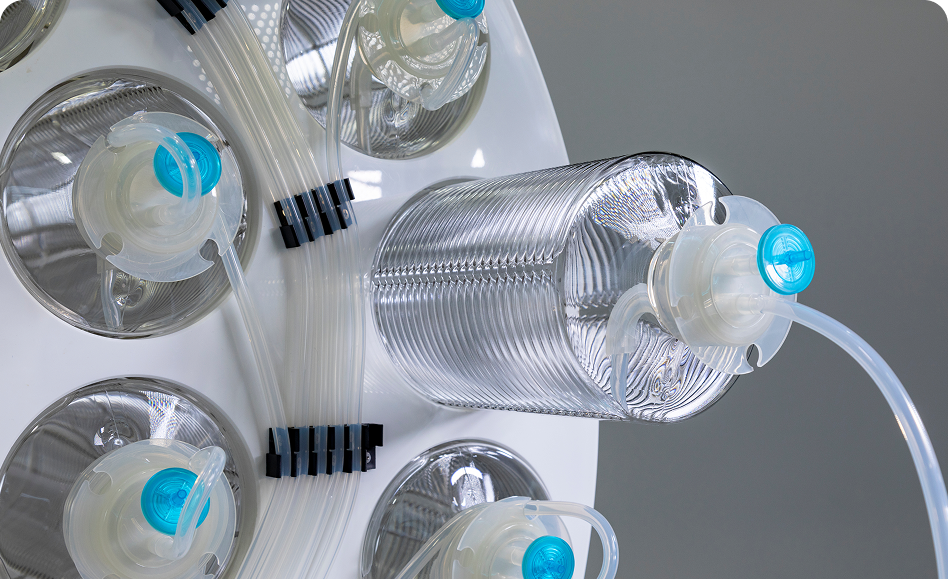
Enter the Roller Cell 40, or, lovingly, the RC-40 for short. SaniSure took what was once a deeply labor-intensive approach to adherent cell culture and automated it, all while keeping the system closed. A room full of technicians manually processing 200 roller bottles can now be handled by a single RC-40 with one operator.
Instead of handling each bottle individually, the RC-40 uses bottle packs: 20 expanded-surface roller bottles linked together by a manifold, forming a closed system with surface area comparable to 200 standard roller bottles. Cell seeding, harvest, media changes, additions, all of it now happens at the touch of a button. The result is less labor, far less risk of operator exposure, and a batch that stays protected from contamination start to finish.
Wary of Changing Your Process? The Writing Is on the Wall
You wouldn’t be the only one. But change is coming whether we welcome it or not. With the European Union’s introduction of Annex 1: Manufacture of Sterile Medicinal Products into its GMP guidelines, the signal is hard to miss.
Roller bottles have been essential to vaccine production for decades, but manual handling of them cannot continue forever. The risks, both to the operator and to the sterility of the product, are simply too high. The EU is recognizing that, and other regulatory bodies will very likely follow. As demand for vaccines and other adherent-cell products climbs year after year, manufacturers have to find ways to meet that demand while keeping one eye on a shifting regulatory landscape.
Roller Bottles Are Here to Stay
They may not be as flashy as newer formats, but they are time-tested and reliable. In many cases, especially with Vero cells in vaccine production, they really are the primary commercial process. What needs to change isn’t the bottle. It’s how we handle it.
That is exactly what the RC-40 offers: a closed, automated system that reduces labor, protects the operator, and minimizes contamination risk, all while taking up less of that valuable space inside your hot room or incubator.
How Do You Get Started?
It’s simple: reach out and let’s talk through your process. I can walk you through not only how the RC-40 can transform the way you work, but how to actually get there. Changing a commercial production process is no small task, and the experts at SaniSure have been helping the industry move from manual roller bottles to closed, automated systems for years. We can map out the path and provide guidance at every step.
It’s time to improve what you already know works, and modernize for tomorrow. I look forward to hearing from you.