Blog

The Dirty Little
Secret of Biotech,
and the Machine
Modernizing It

Roller bottles work. They’ve always worked.
The problem is everything around them.

Adherent cell culture in commercial vaccine manufacturing still runs on roller bottles, a technology that hasn’t changed in decades. The question isn’t whether they work. It’s whether your team can keep up with the labor, the scale, and the regulatory pressure building around manual handling.

Roller Bottle Automation Vaccine Manufacturing EU Annex 1 Ready
Closed System
200-Bottle Equivalent / Unit
Single Operator
Drop-In Process Change

Roller Bottles: The Technology That Refuses to Be Replaced

Roller bottles have been described as “the dirty little secret” of the biotech and pharma industry. They represent an old technology, rarely spoken of, that has barely changed in decades, yet their use remains prevalent in commercial manufacturing.

Simplicity is king.

Roller bottles are not a complex technology, but it is exactly this simplicity that makes them robust and reliable for commercial production. There simply isn’t a lot that can go wrong. When it comes to adherent cells (particularly those used in vaccine manufacturing), roller bottles check all the boxes: ample surface area, excellent gas exchange, minimal media volume requirements, ease of cell harvesting, and genuine gentleness for sensitive cell lines.

In many cases, especially with Vero cells in vaccine production, roller bottles are the primary commercial process. They are time-tested, reliable, and well-understood by regulatory bodies. New technologies continue to emerge, yet demand for roller bottles has continued to grow alongside them. So what’s the problem?

  • High surface area per unit, ideal for adherent cell expansion
  • Excellent gas exchange via continuous rotation
  • Minimal media requirements compared to other formats
  • Gentle handling for fragile or sensitive cell lines
  • Proven track record across vaccine and biologics manufacturing

The technology works. What hasn’t kept pace is the handling of it.

Manual Roller Bottle Handling Cannot Scale: Regulators Are Taking Notice

Roller bottles are a very labor-intensive method of cell growth for commercial production. A single production run may require a room full of technicians manually processing hundreds of individual bottles, handling each one separately for cell seeding, media changes, harvest, and transport. Every manual touchpoint is a contamination risk, an operator exposure risk, and a batch variability risk.

With the European Union’s introduction of Annex 1: Manufacture of Sterile Medicinal Products as part of their GMP guidelines, the writing is on the wall. Although roller bottles remain essential to vaccine production, manual handling cannot continue indefinitely. The risks to operators and to product sterility are too high, and other regulatory bodies are expected to follow the EU’s lead.

The challenge for manufacturers isn’t whether to use roller bottles. It’s whether they can afford to keep handling them the old way as volumes grow and regulatory expectations tighten.

Manual Handling Challenges and Process Consequences
Challenge Root Cause Process Consequence
High labor demand at scale Each roller bottle requires individual handling for every process step Labor costs scale linearly with batch size; production bottlenecks at commercial volumes
Repeated open-system handling Manual processing requires repeatedly opening individual bottles Elevated contamination risk per batch; potential for costly batch failures
Operator exposure risk Direct contact with biological materials during processing and harvest Worker safety risk; PPE burden; HSE audit exposure
Inconsistent manual technique Process outcomes vary with individual operator skill and fatigue Batch-to-batch variability; harder reproducibility demonstration during tech transfer
EU Annex 1 alignment pressure Regulators requiring closed, controlled environments for sterile manufacturing Manual roller bottle lines at risk of non-compliance without process upgrades

The Case for Keeping What Works

Before exploring what needs to change, it’s worth understanding why roller bottles have earned their place. These aren’t legacy limitations. They’re genuine process advantages that no other format has fully replicated for adherent cell production.

Maximum Surface Area

The cylindrical geometry of roller bottles delivers high cell growth surface area relative to media volume, critical for adherent cell lines that cannot be adapted to suspension culture.

Continuous Gas Exchange

Constant rotation ensures cells receive regular gas exchange without active aeration. This passive, reliable oxygen delivery makes roller bottles exceptionally consistent for sensitive cultures.

Minimal Media Volume

Roller bottles require significantly less media per surface area unit compared to large-format bags or bioreactors. For costly media formulations, this translates directly to lower per-batch raw material cost.

Gentle on Sensitive Cells

Unlike stirred-tank bioreactors, roller bottles impose minimal shear stress on cells. This makes them particularly well-suited for fragile cell lines and primary cells used in viral vaccine production.

Regulatory Track Record

Roller bottle manufacturing processes are thoroughly understood by regulators. Decades of submissions, inspections, and approved commercial processes mean fewer unknowns during technology transfer and regulatory review.

Simple Harvest & Scale-Out

Cell harvesting from roller bottles is straightforward and well-established. Scale-out is achieved by increasing bottle count rather than developing a fundamentally different process, which reduces tech transfer risk.

RC-40™: Automate What Works. Don’t Replace It.

A room full of technicians manually processing 200 roller bottles can now be replaced by a single RC-40™ with one operator.

SaniSure has taken what was once a very labor-intensive approach to adherent cell culture and automated it, all while maintaining a closed system. The RC-40™ doesn’t ask you to change your process. It changes how your process is executed.

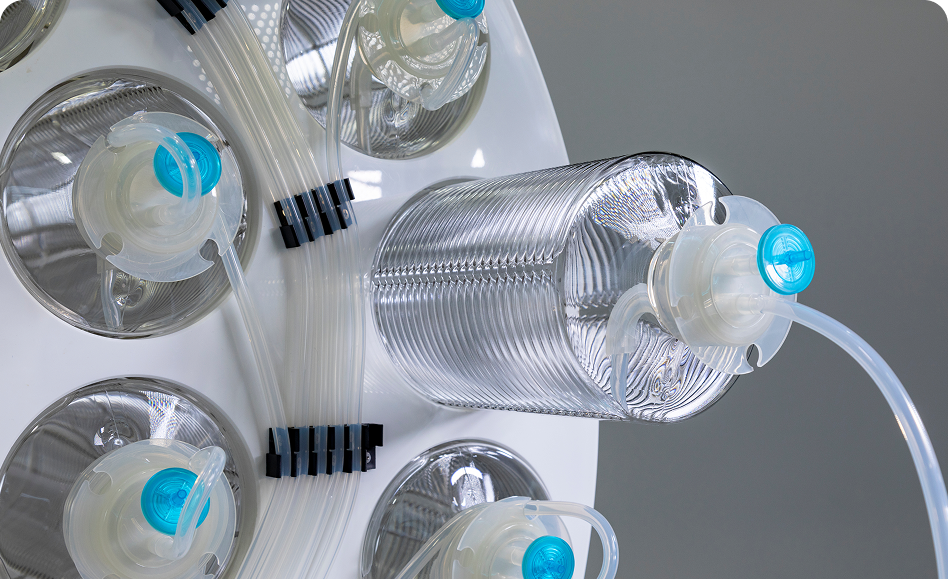
Instead of handling each roller bottle individually, the RC-40™ uses bottle packs: groups of 20 expanded-surface roller bottles linked together by a manifold, creating a closed system with surface area comparable to 200 standard roller bottles. All processes (cell seeding, harvest, media changes, and additions) can now be performed with the touch of a button.

  • Reduces labor from a room of technicians to a single operator
  • Eliminates routine open-system manual touchpoints
  • Substantially reduces the risk of operator exposure to biological materials
  • Protects batch integrity from contamination throughout the process cycle
  • Smaller physical footprint, reclaims valuable incubator or hot room space
  • Designed to preserve your existing roller bottle process, not replace it
Explore RC-40™ on SaniSure.com
RC-40 automated closed-system roller bottle solution showing bottle pack drum assembly
SaniSure Automated Cell Culture
RC-40™
Automated closed-system roller bottle solution.
  • 200-bottle equivalent surface area per unit
  • Single-operator operation, full production cycle
  • Closed manifold system (cell seeding through harvest)
  • Reduced contamination risk and operator exposure
  • Smaller footprint vs. equivalent manual bottle banks
Get Started

It’s Time to Improve
What You Know Works

And modernize for tomorrow.

Changing a commercial production process is no simple task. The experts at SaniSure have been helping the industry transition from manual roller bottle operations to closed, automated systems for years. Whether you’re wary of disrupting a validated process or simply want to understand what the path forward looks like, we can walk you through it, from first conversation through implementation.

Reach out and let’s discuss your process. We can outline the transition, provide guidance at every step, and make sure the RC-40™ fits your application before you commit to anything.

SaniSure Global Product Line Manager Michael Castelli in discussion with customers at INTERPHEX New York 2026
SaniSure at INTERPHEX New York · April 2026
Your Roller Bottle Process
Deserves a Better Partner.
Automation without disruption. Compliance without compromise.

The RC-40™ is designed for manufacturers who want to protect what works while building for what’s next. Let’s talk about your production volumes, your regulatory environment, and how we get there together.